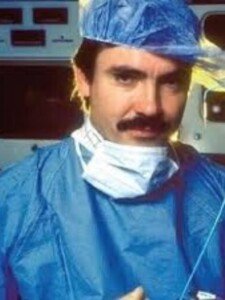
Dr Andreas Gruentzig
Pioneer profile. This is a commemorative entry in the World Elite Doctors hall of pioneers and is not a listing for consultation or referral.
The first coronary balloon
Andreas Roland Gruentzig was born in Dresden in June 1939 and trained in internal medicine and angiology in Germany and Switzerland. On 16 September 1977, at the University Hospital in Zurich, he performed the first percutaneous transluminal coronary angioplasty in a conscious human being — a thirty-eight-year-old man with a proximal left anterior descending stenosis. Interventional cardiology dates from that afternoon.
Built by hand, at the kitchen table
The balloon catheter that made it possible was not supplied by industry. Gruentzig developed it himself over several years, working at home with polyvinyl chloride tubing, refining a non-elastic balloon that would dilate a stenosis without expanding indefinitely. Manufacturers had shown little interest; the device that created a specialty was, quite literally, a homemade one.
Persuading a sceptical profession
His presentation of the first cases to the American Heart Association in November 1977 met open scepticism from a surgical and cardiological establishment invested in bypass grafting. Gruentzig answered it with data and with teaching rather than with argument. His live demonstration courses, first in Zurich and then in Atlanta, are the direct ancestors of every live-case interventional meeting held since, and they set the expectation that a new technique should be shown openly, complications included.
Emory, and the training of a generation
In 1980 he moved to Emory University in Atlanta, recruited to establish an interventional programme, and there trained the operators who carried angioplasty across the United States and beyond. His registry of early cases, meticulously followed, provided the first honest account of what the procedure could and could not achieve.
A career cut short
Gruentzig died on 27 October 1985, aged forty-six, when the aircraft he was piloting crashed in Georgia. He did not live to see stents, drug elution, radial access or primary PCI for STEMI, all of which descend from his balloon. Among the cardiologists he trained was Mathew Samuel Kalarickal, who took the technique to India in 1986.
Qualifications
- Gender
- Hospital Affiliations
- Experience / Tranining
- Medical School
- Internship
- Residency
- Fellowship
- Certifications
- Leadership Roles
Specialties