Description
Cardiology as other specialties meet it
The cardiology a nephrologist needs is not a smaller version of the cardiology a cardiologist needs — it is a different selection. So is the cardiology an intensivist needs, or a respiratory physician, or a surgeon assessing fitness for theatre. Standard references serve none of them well, because they are organised around the specialty rather than around the encounter.
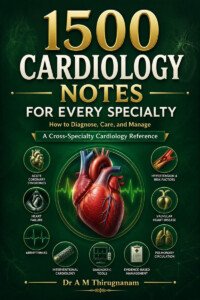
These 1,500 notes across 35 chapters are organised the other way.
Where it is used
Members report three main uses: as a bench reference during clinics where cardiac questions arise unpredictably, as preparation for superspecialty entrance examinations that test exactly this cross-specialty material, and as a teaching resource for departmental sessions where the audience is mixed.
Note format
Single retrievable statements, one per line, with numerical thresholds given as numbers. It reads badly and looks things up extremely well, which is the correct trade for a reference consulted between patients.
Coverage across specialties
Cardiac problems arising in nephrology, endocrinology and diabetes, critical care, respiratory medicine, surgery and perioperative assessment, obstetrics, oncology, and rheumatology.
Suits
Physicians in any medical or surgical specialty other than cardiology, superspecialty entrance candidates, and general physicians covering unselected intake.
PDF, 367 pages, lifetime access, instant download from your World Elite Doctors account.
Notes written for the specialty that is reading them
These cardiology notes for every specialty are not a single text redistributed. The nephrology entries are written around dialysis timing and contrast exposure, the obstetric entries around the physiological changes that mimic disease, the anaesthetic entries around perioperative risk and the drugs that must not be stopped, the oncology entries around cardiotoxicity surveillance.
Fifteen hundred entries, indexed for speed
Each note is a single decision or fact, stated in a few lines, with the threshold or dose attached. The set is indexed three ways — by specialty, by drug and by presenting problem — so it answers in the time available between patients. It is designed to be consulted rather than read, and to be trusted for the specific question rather than relied on as a comprehensive textbook of cardiology.