Description
Acquisition first, because a poor study cannot be rescued
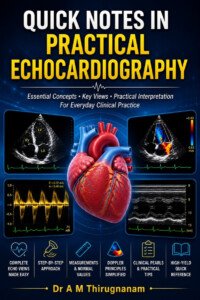
Echocardiography is unusual among cardiac investigations in that the person interpreting it very often acquired it, and no amount of interpretive skill will recover a badly acquired study. Each of these 42 chapters therefore deals with obtaining the view before it deals with reading it.
430 notes, weighted towards measurements that carry decisions: aortic valve area and mean gradient, mitral regurgitation quantification, the E/e′ ratio within the diastolic algorithm, TAPSE and right ventricular assessment, estimated pulmonary pressures, and chamber volumes indexed properly rather than estimated by eye.
For clinicians scanning in their own service
Many members practise where echo is performed by the treating physician rather than a dedicated department — critical care, emergency medicine, rural and district hospital cardiology. The book suits that setting because it never assumes a technologist has optimised the image or that a second opinion is available.
The reporting chapter
One chapter is given to reporting alone, and it is the one clinicians most often say they wish they had read earlier: what belongs in a report, what must never be inferred beyond what the images support, and how to express uncertainty so that the referring doctor treats it as uncertain rather than as a soft yes.
Full coverage
Transthoracic windows and optimisation. Systematic left and right ventricular assessment. The valvular sequence with quantification thresholds. Diastolic function as an algorithm. Pericardial disease and tamponade physiology. Endocarditis. Prosthetic valves. Adult congenital lesions. Stress echo, contrast, strain imaging, and transoesophageal indications.
Suits
Cardiologists, intensivists, emergency physicians, echo technologists and sonographers, and cardiology trainees.
Access
PDF, lifetime access, instant download from your World Elite Doctors account.