Description
The cardiology most doctors actually need
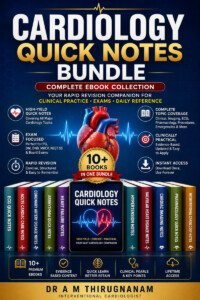
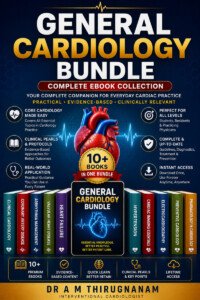
Subspecialty texts are written for people who do one thing all day. Most clinicians do not — the general physician covering an unselected medical intake meets a fraction of interventional cardiology and a great deal of ordinary cardiology, and is served badly by a library built from subspecialty volumes.
This collection covers the ordinary, at the depth ordinary work requires.
Built to be looked things up in
Chapters are short and independently navigable. Thresholds are stated as numbers. Nothing assumes you have read the previous chapter today, because a reference consulted between patients cannot assume continuity — an obvious property that a surprising number of textbooks lack.
Coverage
Clinical assessment and cardiac examination. Ischaemic disease from stable angina to acute presentation. Heart failure. Valve disease. Arrhythmia at general depth, with escalation thresholds stated. Hypertension and lipids. Adult congenital lesions seen in general clinics. Pharmacology throughout, including the interactions that reach across specialties.
Where members keep it
On a phone, mostly. It is the collection our directory reports consulting during consultations rather than after them, which is the practical test of a reference.
Suits
General physicians, internists, family doctors, hospitalists, emergency clinicians, and cardiologists returning to general work after subspecialty practice.
PDF, lifetime access, instant download from your World Elite Doctors account.
The problems that fill a general clinic
This general cardiology reference is organised around presentations rather than diseases, because that is how patients arrive: chest pain that may or may not be cardiac, breathlessness with a preserved ejection fraction, palpitation with a normal resting trace, an incidental murmur, an abnormal ECG in an asymptomatic adult.
Deciding what not to do
Considerable space is given to the negative decision — which patient does not need an angiogram, which murmur does not need serial echocardiography, which ectopy needs reassurance rather than investigation. Overinvestigation is the commonest error in general cardiology and the hardest to unlearn. Each chapter closes with the documentation that protects the decision, which matters when the patient returns two years later with a different story.