Description
Arranged the way patients present
Most cardiology references are indexed by diagnosis, which quietly assumes the reader already has one. The clinician who actually needs help has a patient with breathlessness and no idea yet what is causing it.
These sixteen chapters are arranged by presenting complaint — chest pain, breathlessness, palpitation, syncope, oedema, murmur, abnormal tracing, incidental imaging finding, and the systemic presentations that arrive at cardiology indirectly.
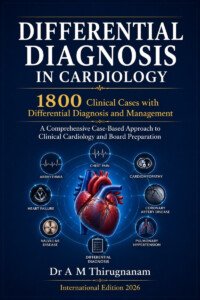
1,800 cases as substitute exposure
Diagnostic skill is a volume problem. A clinician who has seen two hundred presentations of syncope orders differently from one who has seen twenty, and no amount of list-learning closes that gap. Working cases is the only practical substitute for the exposure, and 1,448 pages is a considerable amount of it.
Particularly useful without specialist backup
For members practising where a cardiology opinion means a referral and a wait, the differential is the decision — it determines what is investigated locally, what is escalated and what is safe to observe. Each case is worked in that order rather than presented as a finished diagnosis.
Also a teaching resource
Consultants in the directory commonly use it to run cases with their own trainees, since each is self-contained and can be delivered in a few minutes on a ward round.
PDF, 1,448 pages, lifetime access, instant download from your World Elite Doctors account.
Working from the finding backwards
Differential diagnosis in cardiology is presented the way it is encountered — a finding in search of a cause. Raised troponin without occlusion, a dilated ventricle in a young adult, syncope with a structurally normal heart, unexplained pulmonary hypertension: each opens as a finding, then narrows through the discriminators that actually separate the causes.
Eighteen hundred cases, and what they are for
The volume of cases exists to build pattern recognition rather than to impress. Common diagnoses appear repeatedly in different disguises, which is how recognition is actually trained, and the rare diagnoses appear with the specific feature that should have raised them. Cases are cross-indexed by presenting finding and by final diagnosis, so the book serves both the reader revising systematically and the clinician checking a single puzzling result.