Description
You will meet it as an infarct
Takotsubo arrives as chest pain with ST elevation, and is managed as an acute coronary syndrome until the coronaries are shown to be clear. That is correct. The problem starts afterwards, because a great many clinicians were taught this is a benign condition that resolves on its own.
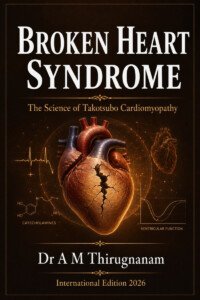
Registry mortality is comparable to acute coronary syndrome. These 245 pages explain why.
The trap worth knowing before you meet it
A Takotsubo patient becomes hypotensive. The instinctive response is an inotrope. If the cause is left ventricular outflow tract obstruction — which is common in the apical ballooning form — the inotrope makes the obstruction worse and the patient deteriorates. Knowing that in advance is the difference between a recovery and a catastrophe, and it is not widely taught.
Other complications
Cardiogenic shock. Thrombus in the akinetic apex, and the anticoagulation decision. Malignant arrhythmia. Genuine recurrence rates. Long-term outcomes worse than the early literature suggested.
The variants that get missed
Midventricular, basal and focal forms, missed because they do not match the textbook image. Secondary Takotsubo triggered by physical illness rather than emotional stress — commoner in hospital inpatients and rarely recognised as such.
Short and worth the evening
Fourteen chapters, 245 pages. Readable in one sitting, and clinicians frequently report it changing their handling of the next case.
PDF, lifetime access, instant download from your World Elite Doctors account.
A diagnosis of confirmation, not exclusion
Takotsubo cardiomyopathy is still too often recorded as what was left when the angiogram was clean. This book sets out positive diagnostic criteria, the regional wall motion patterns including the apical, midventricular, basal and focal variants, the characteristic biomarker and ECG evolution, and the imaging findings that distinguish it from myocarditis and from infarction with spontaneous recanalisation.
The acute phase is not benign
Management is addressed where guidance is thinnest: outflow tract obstruction that contraindicates inotropes, cardiogenic shock, thrombus formation in the akinetic apex, and arrhythmia. Recurrence risk, the physical as well as emotional triggers, and the long-term outcome data are reviewed. A closing section covers what to tell the patient, since takotsubo cardiomyopathy is frequently explained to patients in terms that either frighten or falsely reassure.