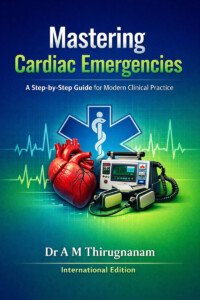
Description
Stabilisation is the beginning
Most emergency references end where the patient becomes stable, which is convenient for the book and unhelpful for the clinician. The mortality that follows a cardiac emergency is not concentrated in the resuscitation room. It accumulates over the next several days, in decisions that individually look minor.
These 496 pages cover that period.
Who is making those decisions
Frequently not a cardiologist. In much of the world the patient is stabilised by whoever is present and then managed on a general ward by general physicians, with cardiology input by telephone. The book assumes that arrangement rather than treating it as an exception.
What it covers
Care after reperfusion and the arrhythmias that follow. The patient who destabilises a second time. Haemodynamic and ventilatory support beyond resuscitation. Renal injury after contrast and after low output. Bleeding on antithrombotics — graded, and managed rather than reflexively reversed. Infective complications. Delirium. Discharge planning and the follow-up interval that actually reduces readmission.
Resource-realistic
Where a decision depends on a facility that may not exist locally — advanced support, an available catheter laboratory, a particular assay — the book says what to do without it. That is unusual in emergency texts and is why it suits an international readership.
PDF, 496 pages, lifetime access, instant download from your World Elite Doctors account.
Recognition before treatment
Cardiac emergencies management begins with the presentations that are missed rather than mistreated: the aortic dissection presenting as stroke, the posterior infarct with unremarkable anterior leads, the tamponade in a patient assumed to be septic, the hyperkalaemic rhythm mistaken for ischaemia. Each is given the discriminating feature and the confirmatory step.
A handbook that works under pressure
Layout matters in an emergency, so each condition occupies a fixed structure — recognise, stabilise, confirm, escalate — with doses in full and the common dosing error named. Paediatric and pregnancy variants are flagged where the management genuinely differs. The final section covers the two things that most often go wrong after the emergency itself: the handover call, and the documentation that will be read months later at review.