Description
The emergencies that do not wait for the cardiologist
Cardiogenic shock, unstable wide-complex tachycardia, the post-arrest tracing that decides whether a transfer is activated — these present at the hours when specialist support is thinnest, in departments where it may not exist at all. The decision is made by whoever is present.
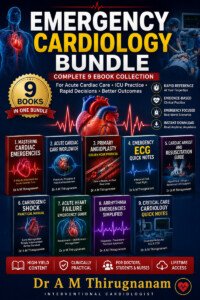
This nine-volume collection is written for that clinician. It covers the whole of emergency cardiology at a level of operational detail that a single handbook cannot carry.
Why the detail matters at the bedside
“Consider inotropic support” is not an instruction anyone can act on at four in the morning. What is needed is the agent, the dose, the line, the monitoring, and the point at which no response means escalating rather than repeating. Each volume specifies at that level.
Scope across the nine volumes
The volumes are organised by how the patient arrives rather than by diagnosis. Chest pain and the infarct pathway occupy the first two, taken from the door through to reperfusion, with particular attention to which tracings justify calling a lab out of hours. Two more deal with the patient who is shut down: pump failure needing pressors or a device, and the arrest and its aftermath. One covers the patient whose rhythm is the emergency. Another takes breathlessness and flash pulmonary oedema. The last three handle the catastrophic presentations — a dissecting aorta, an effusion under pressure, blood pressure at crisis level, a valve that has failed suddenly — and the complications that follow a procedure.
Antiplatelet and anticoagulant choices are treated as things decided at a trolley: what to load, whether platelet reactivity testing is available and worth doing, and how bleeding severity is graded when someone has to choose between stopping an agent and continuing it.
Transfer and escalation
For members in hospitals without interventional facilities, the transfer criteria are stated explicitly throughout: which patients need a cath lab within ninety minutes, which can be stabilised locally, and what must be done before the ambulance leaves.
Suits
Emergency physicians, intensivists, acute physicians, coronary care nursing staff, retrieval teams and general physicians covering unselected acute intake.
Access
Nine PDF volumes, lifetime access, from CardiologyBooks.com.