Description
The decade before anything happens
Coronary disease builds for twenty or thirty years and announces itself in an afternoon. The whole period in which it is cheapest to alter is the one where the person feels entirely well and rarely sees a doctor — and where any intervention has to be justified to someone with no symptoms.
These 333 pages are about that period, and about the justification.
Honest about cost and access
Unusually for a book on early detection, it treats affordability as a clinical variable rather than an inconvenience. Calcium scoring and CT angiography are self-funded for most patients in most of the world. Recommending a test a patient must pay for demands a clearer justification than ordering one the system absorbs, and the book supplies the reasoning for that conversation.
The detection tools
Coronary artery calcium scoring, what a zero score means and how long it stays reassuring. CT coronary angiography used for risk rather than symptoms. Carotid intima-media thickness and why it fell from favour. Lp(a) and high-sensitivity CRP. Why ten-year risk calculators mislead in younger patients whose lifetime risk is high — the group where early detection matters most and conventional scoring least.
Whether to act on it
Handled without overclaiming. Screening well people has costs, false positives generate cascades of anxiety and investigation, and treating on imaging findings alone is not uniformly supported. That restraint is what makes the book credible.
Suits
General physicians, family doctors, cardiologists and preventive health services.
PDF, lifetime access, from CardiologyBooks.com.
The decades before symptoms
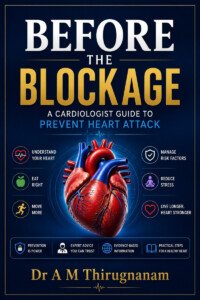
Preventing heart disease early means acting in the twenty or thirty years during which atherosclerosis develops silently and nothing hurts. The book explains what is accumulating during that period, why a normal stress test at fifty says little about plaque burden, and which measurements — lipoprotein(a), coronary calcium, apolipoprotein B, blood pressure trajectory — actually add information in an asymptomatic adult.
Written to be acted on
Each risk factor is followed by what changes it, at what magnitude, and over what timescale, so readers can judge effort against benefit rather than attempt everything at once. Family history, South Asian and other high-risk ancestries, and the risk that accrues from conditions such as hypertensive pregnancy or inflammatory disease are addressed directly. The tone is factual rather than alarming; preventing heart disease early is presented as a series of ordinary decisions repeated, not a programme.