Description
Most of your clinic, least of the evidence
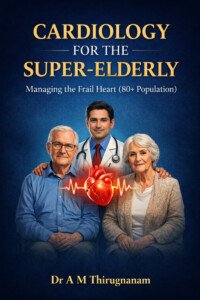
Older patients now make up the majority of most cardiology and general medical clinics, and the smallest share of the trial populations behind the guidelines used to treat them. Every clinician handles that mismatch daily; very few were ever taught how.
These 274 pages are about doing it deliberately rather than by instinct.
Frailty, measured
Frailty predicts outcome better than age and is almost never recorded. The book is practical about which scoring instruments survive a busy clinic and what each result should actually change — which is the question that matters, since a score that changes nothing is not worth the minute it costs.
Presentations that get missed
Infarction without chest pain. Heart failure presenting as confusion or a fall. Aortic stenosis attributed to ageing for two years. Atrial fibrillation discovered after the stroke it should have prevented. Each has a recognisable pattern, and each is missed routinely in exactly the settings where a second opinion is hardest to obtain.
The decisions with no comfortable answer
Anticoagulating when both stroke and bleeding risk are high, which describes much of this population. Deprescribing, structured rather than opportunistic. Revascularisation and valve intervention in the very old, with honest treatment of when TAVI helps and when it extends a decline. Ceilings of care.
Suits
General physicians, geriatricians, family doctors, cardiologists and nursing staff.
PDF, lifetime access, via CardiologyBooks.com.
When the guideline population is not your patient
Geriatric cardiology begins from the fact that the trials underpinning most recommendations excluded the patient in front of you. The book addresses frailty assessment as a routine cardiological measurement, competing risk, and the point at which a life-prolonging intervention stops being in the patient’s interest.
Deprescribing, and the tertiary decision
Polypharmacy, falls, orthostatic hypotension, cognitive impairment and adherence are treated as cardiological problems rather than someone else’s. A full section covers structured deprescribing — which agents to reduce first, in what order, and how to monitor. The tertiary end is addressed with equal candour: TAVI, device therapy and revascularisation in the very old, where geriatric cardiology has the most to offer and where selection, not technique, determines whether the patient benefits.