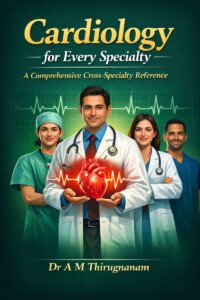
Description
Cardiology arrives in every specialty
The patient does not present to cardiology first. They present to the surgeon who must decide whether to operate on a stented patient, to the nephrologist balancing volume against a failing ventricle, to the obstetrician with a murmur that was not there last trimester, to the emergency physician at three in the morning with an ECG and no cardiologist on site.
None of those doctors need a cardiology textbook. They need the cardiology that touches their own work, at the depth the decision requires. This 411-page handbook is arranged accordingly — by the clinical situation, not by the anatomy.
The escalation question
What distinguishes it from a general reference is that it states thresholds for calling for help explicitly. For a physician practising in a hospital without on-site cardiology — which describes a substantial share of our directory — that is the most consequential information in the book. Knowing which arrhythmia can be managed locally and which mandates transfer is a different skill from knowing what the arrhythmia is.
Chapter coverage
Perioperative cardiac assessment and antiplatelet interruption. Heart failure with renal impairment. Arrhythmia recognition and escalation. Cross-specialty drug interactions. Chest pain triage. Valve disease before non-cardiac surgery. Cardio-oncology. Cardiac manifestations of endocrine and autoimmune disease.
Antithrombotic sections use the standard vocabulary — DAPT, TAT, DAT, HAS-BLED — and cite the trials behind current duration guidance, including TWILIGHT, AUGUSTUS and PIONEER AF-PCI.
Directory members it suits
Anaesthetists, intensivists, nephrologists, endocrinologists, pulmonologists, surgeons, obstetricians, emergency and family physicians, and hospital medicine specialists.
PDF, lifetime access, instant download from your World Elite Doctors account.
Who reaches for it, and when
Cardiology for every specialist is written for the physician, intensivist, anaesthetist, nephrologist, obstetrician and surgeon who inherits a cardiac problem without inheriting a cardiologist. The framing throughout is the referral decision: what can be safely started before the opinion arrives, what genuinely cannot wait, and which investigations change management rather than merely documenting the disease.
Format and clinical use
Each chapter opens with the presentation as it actually reaches a non-cardiac ward, then moves to the immediate decision, then to what the cardiologist will want to know when called. Landmark evidence is cited by trial name where it changes the threshold, so a reader can defend the decision on a ward round. Sized for a pocket or a phone screen, and written to be read in the four minutes available before the patient is seen.